
Emergency Window Installation Near Me: What Homestead Homeowners Should Do First
If a window is broken or breached in your Homestead home, the first call should not be to an installer. The first thirty minutes belong to documentation, securing the opening against weather, and protecting your insurance claim. Once those steps are done, the right emergency window installer in Homestead can get the opening properly measured, quoted, and replaced, often within the same week. If you’d rather not manage the first steps alone, call TruePane Windows & Doors at (448) 428-7290 and we’ll walk you through it.
Calling an emergency window contractor before you photograph, measure, and temporarily secure the opening correctly is one of the costliest mistakes a Homestead homeowner can make. Not because installers are dishonest. Because insurance adjusters are methodical, and the sequence of what happened before the board went up matters more than most people realize. Miss that sequence and you can lose control of the claim, the repair, or both.
Key Takeaways
- Document the damage before you touch anything: photos, measurements, and a written description of the cause.
- Board or tarp the opening correctly for South Florida wind, or hire someone who will.
- Know the difference between a board-up service and an emergency window installer. You likely need the first within 24 hours, the second within 72.
- Watch for assignment-of-benefits pressure from storm-chasing solicitors. It strips you of claim control.
- A legitimate installer asks questions before quoting. If they don’t, be cautious.
Why the First Thirty Minutes Decide Everything
Here’s the reality we’ve learned serving Homestead since 2008: a broken window is two problems at once. There’s the physical problem, an opening in your home’s envelope that lets in weather, pests, and anyone willing to climb through. And there’s the claims problem, a loss that your insurer will evaluate based on what they can see and what you can prove. Both problems get worse with delay, but the order in which you address them changes the outcome.
Your first job is documentation. Before you move a single shard of glass, take photos. Wide shots showing the entire window and the room around it. Close shots showing the point of impact, the glass pattern, the frame condition, and anything that came through the opening, a branch, a rock, a tool. If you have a tape measure, record the rough opening width and height, plus the visible glass dimensions. Write down the date, the approximate time, and what you believe caused the breach. That written description matters more than you’d think, especially when a storm-related claim is being reviewed against wind-speed data for your Homestead zip code.
Only after you’ve documented everything should temporary covering begin. If you board or tarp first, the adjuster arrives to a covered opening and a story with no visual record. That’s a weak claim position.
Boarding a Window in South Florida Wind: What Actually Holds
Homestead wind is not a gentle breeze. We’ve pulled plywood out of neighbors’ yards after the first squall line because someone thought two drywall screws would hold a 4-by-8 sheet against a summer storm gust. If you’re boarding a breached window yourself, use 5/8-inch CDX plywood, not OSB, which swells and loses strength when wet. Cut it at least 4 inches larger than the opening on every side. Secure it to the exterior wall with 2-1/2-inch or longer exterior-grade screws or lag bolts through pre-drilled holes every 12 to 16 inches. Do not screw into window trim alone; anchor into the wall framing around the opening.
Better than plywood in many cases is a heavy-duty tarp with grommets, secured by furring strips screwed into the framing, not stapled or tied. Tarps flex less under wind load and are far lighter to install. But they fail if water pools. Angle the tarp so runoff moves away from the wall. If the breach is on a second story or involves a large picture window, do not get on a ladder with a sheet of plywood in a wind event. That is a fall waiting to happen.
The goal of boarding is not repair. It is preventing secondary damage, water, pests, intrusion, that an adjuster could attribute to homeowner neglect rather than the original event. We’ve watched otherwise strong claims get reduced because water damage from an improperly sealed board-up was blamed on the homeowner. Get the board right the first time.
Board-Up Service vs. Emergency Window Installer: You Need Both, Just Not at the Same Time
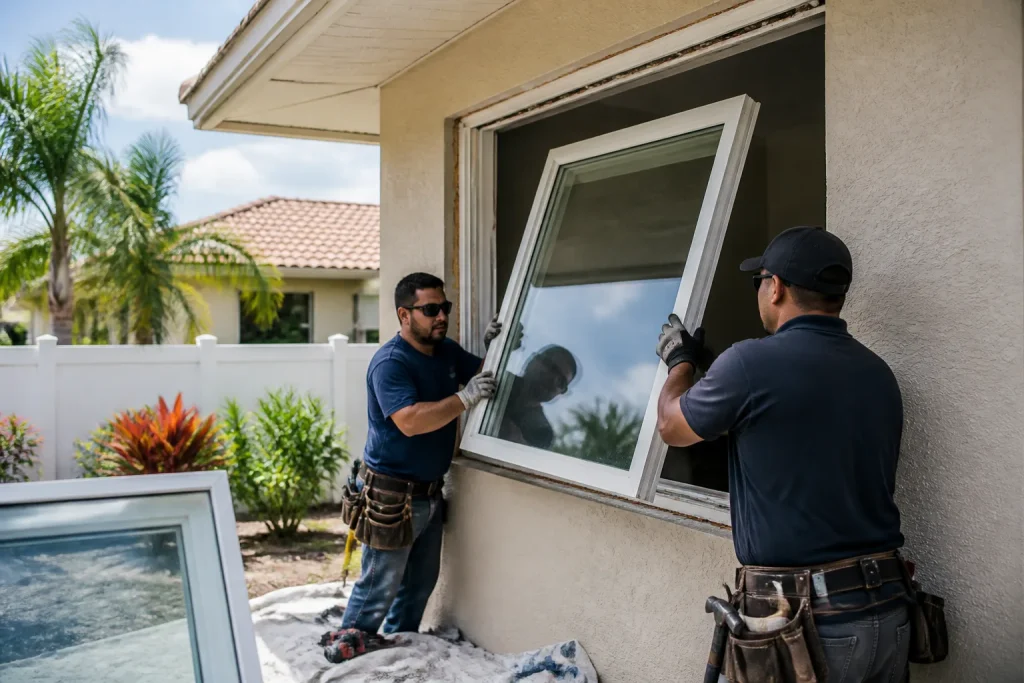
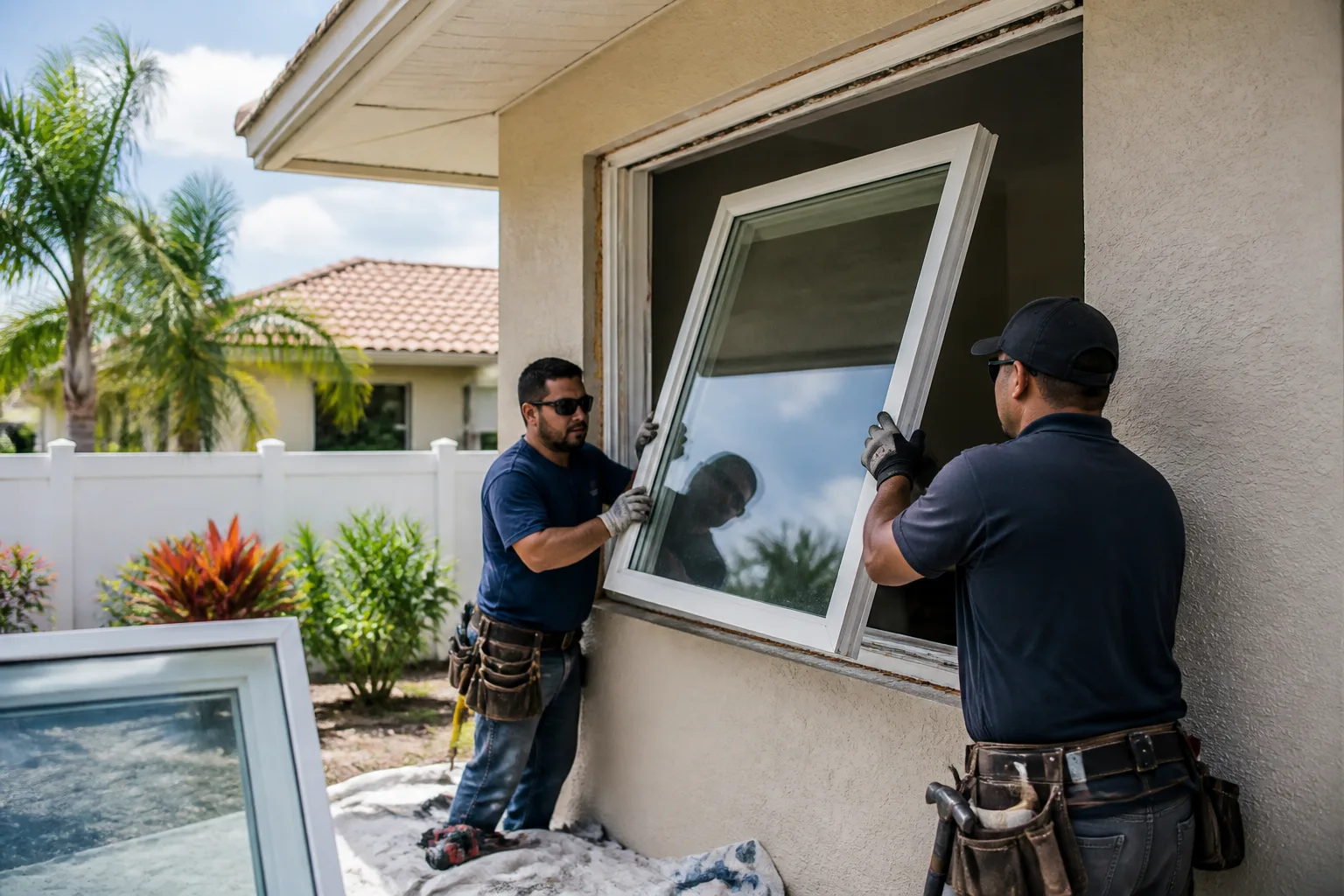
These are two different jobs, and conflating them costs Homestead homeowners time and money. A board-up service secures the opening fast. They show up, clear the glass, cover the breach, and leave you with a weather-resistant, reasonably secure home. That’s a first-24-hours job. An emergency window installer measures, quotes, orders or pulls the replacement unit, and performs a permanent installation. That’s a first-72-hours job, sometimes longer if you have impact glass or a custom size on order.
In our experience, the ideal sequence is: document, secure, then call an installer. Not the reverse. If you call an installer first and they’re quoting you a board-up fee plus an install fee without asking about your insurance timeline, slow down.
Here’s the thing about Homestead specifically. This is hurricane country. A lot of homes here have impact windows from manufacturers like PGT, CGI, or CWS. If your breached window is an impact unit, the replacement needs to match not just the size but the design pressure rating and product approval for Miami-Dade and Broward. That’s not a stock item at a big-box store, and it’s not something a night-time board-up crew is carrying. A legitimate installer will ask what’s currently in the opening before quoting anything. We do, every time.
Red Flags in Storm-Response Solicitations Specific to Homestead
After any storm that puts windows out in South Florida, the solicitations start. Fliers. Door knocks. Calls from numbers you don’t recognize. Some are legitimate local companies working overtime. Some are not, and a few are actively harmful to your claim.
The single biggest red flag we tell Homestead homeowners to watch for is the assignment of benefits, or AOB, pressure tactic. Here’s how it works. A contractor asks you to sign a document assigning your insurance benefits directly to them. It sounds harmless, like paperwork they’ll handle so you don’t have to. What it actually does is transfer your claim control to the contractor. They bill the insurer directly, and if they bill more than the insurer approves, you can end up in the middle of a dispute you didn’t create. Some AOB situations end fine. Many do not. If anyone asks you to sign an AOB before they’ve even looked at the window, that’s your cue to end the conversation.
Other red flags: quoting a price without measuring the opening, refusing to provide a written line-item estimate, demanding full payment upfront, or saying they’ll “handle the insurance for you” before you’ve filed a claim. A real installer in Homestead quotes from the measured opening, writes the price down, and lets you own your claim from start to finish. We’ve spent 42 years in this line of work. The companies that stay in town that long are the ones that want your signature on a written quote, not your benefits on a form.
What a Legitimate Emergency Installer Asks Before Quoting
If you’ve never bought a replacement window before, the questions an installer asks can feel like delays. They’re not. They’re how a professional avoids selling you the wrong unit for a Homestead house, and they’re how you know you’re talking to someone who knows what they’re doing.
A legitimate installer will ask:
- Is the broken window impact-rated or standard glass? If you’re not sure, they’ll check the corner etching or the frame label.
- What are the rough opening measurements? They’ll take their own regardless, but your numbers tell them you’ve been paying attention.
- Is this an insurance claim or out of pocket? The answer changes the paperwork, not the price. A square deal is the same either way.
- When did the damage happen and has the opening been dried out? Wet framing absorbs fasteners differently. We need to know.
- Is there water intrusion beyond the window itself, into the wall cavity or flooring? That’s not a window quote anymore. That’s a remediation conversation.
These questions slow the phone call down by about four minutes and save weeks of trouble later. If an installer quotes a window sight-unseen over the phone without asking a single one of these, that’s not speed. That’s a guess with your money attached.
When to Call a Pro
You should call a professional the moment the board-up is done, or sooner if you’re not comfortable on a ladder or with a drill. A breached second-story window is not a DIY board-up in South Florida wind, and neither is any opening larger than a standard double-hung. If you’re in Homestead and the opening is more than 48 inches wide, get help. The sheet of plywood that looks manageable on the ground becomes a sail at the top of an extension ladder.
We’ve built our company around a simple rule: if the pane is not true, the job is not done. That rule applies to the temporary board as much as the permanent glass. Window Installation in Homestead is what we do every day, and for full-unit Window Replacement in Homestead, we measure every opening twice and quote manufacturer lines side by side on paper so you see exactly what you’re buying. For damage that extends beyond the glass to the entry itself, our Door Installation in Homestead team handles that move-for-move.
One story from last hurricane season. A homeowner in the Redland called us about a blown-out living room window. She’d already boarded it with two layers of tarp and a furring-strip frame she’d built herself, neat as a cabinet maker’s best day. Her adjuster approved the full replacement in six days because the documentation and the board-up were both done right. That’s not luck. That’s sequence.
The Bottom Line
When a window is breached in your Homestead home, the order of operations protects both the structure and the claim: document first, secure second, call the installer third. Board it correctly for South Florida wind, avoid assignment-of-benefits pressure, and expect a real installer to ask questions before quoting. The people who skip those steps are the ones who end up fighting their insurer or living with a window that was never right to begin with.
If you’re in Homestead and dealing with a broken window right now, or want to price a permanent replacement before the next storm season, TruePane Windows & Doors offers free estimates. Call (448) 428-7290 and a live person will answer. Not a voicemail tree. Not a callback form. A person who knows windows and knows Homestead.
Frequently Asked Questions
For a standard single-hung or casement window in Homestead, expect to pay between $400 and $1,200 installed, depending on size, material, and whether it’s impact-rated. Impact windows, which many Homestead homes require under current building codes, run higher, commonly $1,500 to $3,500 per opening for brands like PGT, CGI, or Ply Gem. If the damage is claim-covered, your out-of-pocket depends on your deductible. Get a written line-item quote before committing. Call (448) 428-7290 for an exact number on your specific window, the estimate is free.
It shouldn’t, if you’re working with a company that quotes from a measured opening and writes the number down. At TruePane, the price on your written quote is the price on the bill. The only exception is when we open a wall and find hidden damage that changes the scope, in which case we stop, show you what we found, and get your approval before doing anything else. No surprise line items. No change orders you didn’t sign.
If we have the correct unit in stock or can pull it from a local supplier, installation can happen within a few days of the quote. Custom sizes or impact-rated units with specific design pressure approvals can take one to three weeks, because they’re built to order, not pulled off a shelf. The board-up you put in place on day one carries you through that wait. TruePane Windows & Doors home is where you can see the full range of what we install, including hurricane-rated lines for Homestead’s building requirements.
For a like-for-like glass replacement in an existing frame, generally no. For a full frame replacement or an upgrade to impact glass, Homestead building requirements often trigger a permit, and we pull it. We don’t ask homeowners to handle their own permitting. The permit gets pulled, the inspection gets scheduled, and the work gets signed off. If a contractor tells you the permit is “optional,” call someone else.
Written by Dale Kessler, Owner at TruePane Windows & Doors, serving Homestead since 2008.
Need Windows & Doors Help?
Call TruePane Windows & Doors - licensed & insured, here with fast after-hours help in Homestead.
(448) 428-7290