
Pella Window Installation in Homestead: A Homeowner’s Guide
Pella window installation in Homestead costs between $850 and $2,400 per window depending on series, glass package, and whether the opening needs structural work. The number that matters more is what you’ll spend five years from now if the unit gets set wrong. In Miami-Dade County, a Pella window installed without the proper Notice of Acceptance documentation isn’t just a code violation; it’s a manufacturer warranty that quietly voids itself the day the county inspector walks away.
We’ve spent years pulling failed windows out of Homestead homes, and the pattern is always the same. The window was a good window. The installation was not. This guide covers what actually determines whether your Pella units survive South Florida, from the flashing details nobody photographs to the anchoring schedule salt air demands. If you’d rather skip the research and talk to someone who installs Pella in Homestead weekly, call (448) 428-7290 for a free estimate.
What Miami-Dade NOA Requirements Mean for Your Pella Windows
Miami-Dade County has the strictest building code in the continental United States, and the Notice of Acceptance system is the part that trips up homeowners who buy windows online or through a big-box store. An NOA is a product approval document proving a specific window model, with a specific frame and glazing configuration, has passed impact testing and pressure cycling for high-velocity hurricane zones. Not every Pella window carries a Miami-Dade NOA. If you buy a Pella series approved for the Florida panhandle and have it shipped to Homestead, the county will not pass it, your insurance company will not honor storm claims associated with it, and you’ll have paid full price for a unit that has to come back out.
The Pella Architect Series and Pella Impervia lines both have configurations approved for Miami-Dade, but only in specific sizes and impact glass packages. An installer who works in Homestead regularly knows to pull the NOA drawing before ordering; an installer who works mostly in Broward or points north may not think to check it until the window is sitting in your driveway. Ask the installer to show you the Miami-Dade NOA number for the exact Pella model being quoted. If they can’t produce it within a day, move on.
This is also where the warranty language gets interesting. Pella’s warranty documents expressly exclude coverage for failures that result from installation not in compliance with local code. A window that doesn’t carry the proper NOA is, by definition, installed out of code compliance. The warranty is dead before the caulk cures. We register both manufacturer warranty layers in writing, with durations stated, before the truck leaves your Homestead driveway. You get a copy; we keep a copy. No arguing later about what was covered.
The Sill Pan Flashing Detail Most Homestead Crews Skip
In a South Florida rough opening done correctly, there’s a formed plastic or metal pan under every window, shaped to catch any water that finds its way past the frame and direct it out over the face of the wall instead of into the framing. Homestead’s summer storms deliver water horizontally, not vertically. A window can be perfectly sealed on all four sides and still leak at the sill if the pan is missing, because wind-driven rain gets forced up under the bottom flange and behind the weep system. The pan is the only thing standing between that water and your king studs.
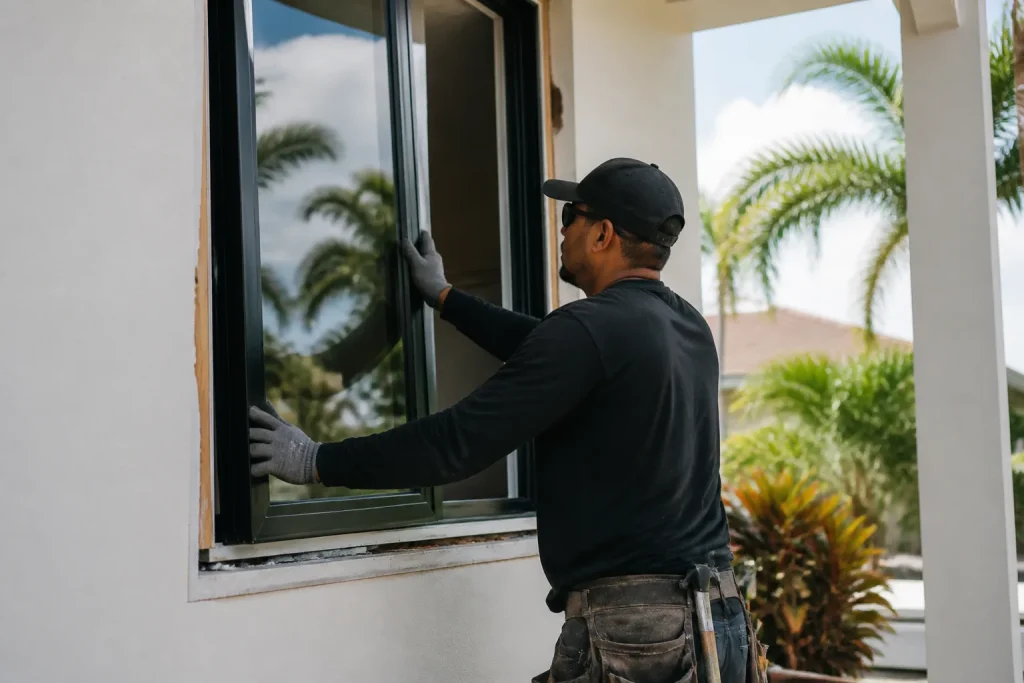
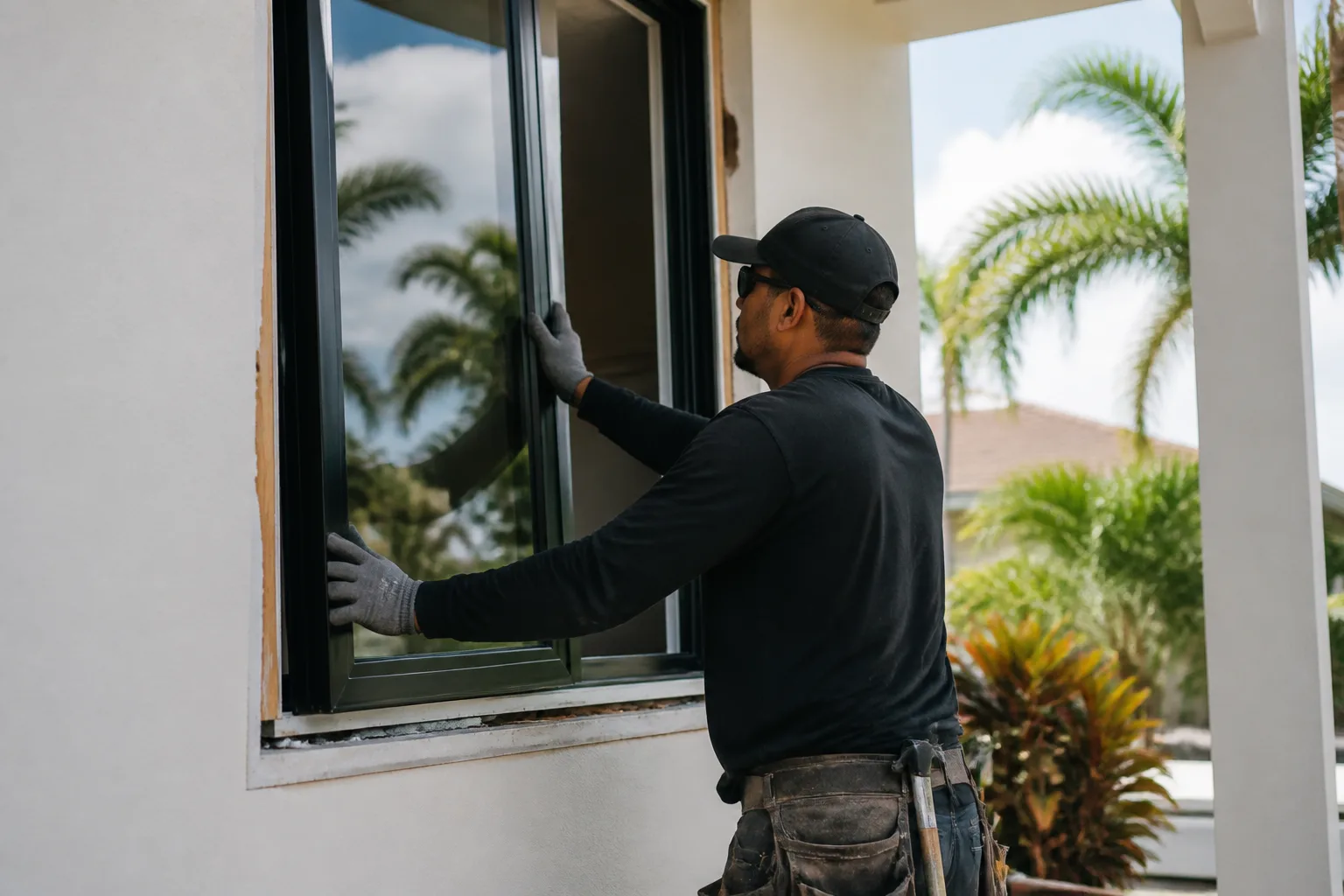
Two shortcuts are common enough that we see them dozens of times a year. The first is skipping the pan entirely and relying on a bead of sealant across the bottom of the opening. Sealant is a gasket, not a drainage system. It fails, and it fails quietly. The second shortcut is using a flat piece of peel-and-stick flashing laid across the sill instead of a formed pan with upturned end dams. Without the end dams, water runs off the ends of that flat strip and straight into the framing at the corners. A correctly done Pella installation in Homestead means removing the old window, inspecting the rough sill for rot, flashing the sill with a sloping pan, then setting the Pella unit on a continuous shim bed that’s sealed to the pan. The pan slopes out. The end dams are sealed to the opening. Every one of our rough openings gets photographed before the window goes in, because after the trim goes back on, nobody can see what’s under there unless they pull the window.
Rot takes about three years to show itself in Homestead’s humidity. By the time the paint blisters and the drywall softens under the sill, the framing has been wet for two of those years. Homeruns of termite-damaged, water-rotted sills under Pella windows are not rare. They’re routine, and they all share the same root cause: the pan was never there.
Pella’s Two-Layer Warranty and the Documentation That Keeps It Alive
Pella’s base warranty covers defects in materials and workmanship of the window itself: glass seal failure, hardware functioning, frame issues. It does not cover labor to remove and replace a failed unit; it does not cover installation errors. The extended coverage layer, which Pella sells as an upgrade, adds things like glass breakage coverage and longer seal-failure protection, but it carries a conditional requirement: the window must be installed by a Pella-certified contractor following Pella’s published installation instructions to the letter. Skip the certification, and the extended layer doesn’t apply. The base layer also excludes damage from improper installation, so if the unit fails because it was set wrong, neither layer pays.
What most homeowners don’t realize is that both warranty layers require registration with Pella after installation, and that registration asks for the installer’s name and certification information. If you buy a Pella window and some handyman crew sets it, you can register the warranty, but when you file a claim three years later for a fogged seal, Pella will ask who installed it. The moment they learn it wasn’t a certified Pella installer, the claim is done. Keep the installation invoice. Keep the certification number. Keep both warranty registration confirmations. File them somewhere dry. We register both layers in writing before we leave the driveway, under the Keystone Standard, and we hand you the paper copies. If you’re in Homestead and have a Pella window currently going bad, window replacement in Homestead is something we can assess while we’re there.
Salt Air, Anchors, and Sealant: What the Generic Guides Miss
Homestead sits close enough to Biscayne Bay that salt air reaches every neighborhood, not just the ones with water views. Aluminum frames and stainless hardware corrode faster here than they do twenty miles inland. Pella’s aluminum-clad wood windows hold up well, but only if the installation uses the right anchoring schedule and the right sealant. Generic installation guides written for a national audience recommend a certain number of fasteners per side based on wind load tables. In Miami-Dade, the mandated anchor schedule is denser, and the fasteners themselves matter. A zinc-plated steel screw in a Pella window flange will rust through within a few years in Homestead’s salt air. We use stainless steel anchors, countersunk and capped, with the spacing dictated by the NOA drawings, not the generic guide.
Sealant is the other one. The big-box acrylic and latex caulks are fine for a window in Tennessee. They will not survive a decade of Homestead UV and salt. The correct product is a marine-grade polyurethane or a high-grade silicone hybrid that’s rated for coastal exposure and remains flexible through the thermal expansion and contraction cycles South Florida windows go through daily. We use products formulated for marine environments on every coastal install. The finish glazing bead should be tooled, not finger-smoothed, so it bonds fully to both surfaces. These details show up in the warranty language as “installation in accordance with Pella’s coastal installation supplement,” which almost nobody ever reads until a claim comes back denied.
A salt-air Pella install done right will last thirty years. Done with the wrong sealant and interior-grade anchors, it’ll start showing frame corrosion at the seams in five. The brand on the window doesn’t determine the outcome. The set does. We do window installation in Homestead with the anchor schedule and sealant spec the climate demands, and that is not a detail we treat as optional.
Questions to Ask Any Installer Before They Touch a Pella Unit
The difference between an installer who has done this work in South Florida and one who merely owns a truck and a caulk gun shows up fast when you ask the right questions. Here’s what to hit them with, and what honest answers sound like.
- “Show me the Miami-Dade NOA for this exact Pella model.” The answer should be a document number, not a shrug. If they tell you “we don’t usually need that for Pella,” call a different company.
- “What do you put under the sill?” The answer should include the words “sill pan” and “end dams.” If it is just “we caulk the bottom real good,” the install is already wrong.
- “Are you a Pella-certified installer, and will you register the warranty?” If they hesitate, or tell you “you can register it yourself later,” that warranty is not going to be worth the paper to you.
- “What sealant do you use on coastal installations?” A blank look here tells you everything. The answer should name a marine-grade polyurethane or silicone hybrid, not “whatever the supply house has.”
- “Will I get the NOA number, the certification number, and both warranty registrations in writing?” If the answer to any piece of this is not yes, walk away. The paperwork is not a nice-to-have. In Homestead, the paperwork is the product.
These questions do not make you difficult. They make you an informed buyer. The difference between a correct Pella installation and a warranty that quietly dies in year four is often nothing more than the installer’s willingness to answer them. We pulled a Pella unit out of a house out in Country Walk last month where every one of these details had been skipped. The window was fine. The install was a teardown. The homeowner paid twice: once for the bad install, once to have it undone and redone.
When to Call a Pro
Pella windows are not a DIY-friendly product in Homestead. Between the NOA requirements, the anchor schedule, and the flashing details, this is work that needs a trained installer with local code experience. If you’re seeing water stains under the sill, condensation between the glass, or a window that sticks when the humidity climbs in July, get it looked at before the framing damage spreads. A bad Pella install doesn’t fail all at once; it fails in slow motion, and every season it sits, the repair bill grows. Our technician will measure, quote Pella and Andersen and Marvin side by side on paper, and tell you honestly whether the window needs replacing or just the install needs fixing. That’s TruePane Windows & Doors doing what we’ve done in this community for over 42 years, across two generations.
Related Services in Homestead
If your Pella windows are beyond saving, or if you’re in the middle of a whole-home project and need a full window replacement in Homestead, we quote complete openings, not just glass. Our door installation in Homestead work follows the same standard: both warranty layers registered, both NOAs correct, every opening photographed. And for anyone weighing whether to repair or replace, our window installation in Homestead page covers the full range of what a proper install actually involves.
What happens when you call
- 1
A real person answersNo phone trees - you reach a local pro.
- 2
You get an upfront price rangeHonest numbers before anyone is dispatched.
- 3
A background-checked tech heads outLicensed & insured, dispatched right away.
- 4
You approve before work beginsNothing starts until you say go.
The Bottom Line
Pella makes a good window. In Homestead, the window is only half the purchase. The other half is the installation: the sill pan, the flashing, the NOA documentation, the anchor schedule, the sealant, the warranty registration. Get any piece wrong and the warranty is a piece of paper with fine print that covers neither. Get them all right, and a Pella window set correctly in Homestead is a thirty-year window.
If you’re in Homestead and need help thinking through a Pella installation or replacement, TruePane Windows & Doors offers free estimates. Call (448) 428-7290 and a live person answers, day or night. No voicemail tree. No callback form. We’ll be there when we say. If the pane is not true, the job is not done.
Frequently Asked Questions
Pella window installation in Homestead typically runs $850 to $2,400 per window, with the final number depending on the series, impact glass requirements, and whether the rough opening needs structural repair. Call (448) 428-7290 for a free line-item estimate on your specific openings.
No. Pella’s warranty covers defects in the window itself, not failures caused by improper installation. If a non-certified contractor sets the window wrong and the unit fails as a result, the claim will be denied. That’s why both warranty layers must be registered in writing, with the installer’s certification on file.
Yes. Homestead is in the Miami-Dade high-velocity hurricane zone, and any window installed there must carry a Notice of Acceptance specific to the exact model and configuration. Without it, the county fails the inspection, and the Pella warranty exclusion for non-compliant installation kicks in.
Most single-window and full-home Pella installations in Homestead are completed in a single visit, typically one to two days depending on the number of openings and whether old-frame rot needs repairing. We quote the timeline up front and stick to it.
Written by Dale Kessler, Owner at TruePane Windows & Doors, serving Homestead since 2008.
Need Windows & Doors Help?
Call TruePane Windows & Doors - licensed & insured, here with fast after-hours help in Homestead.
(448) 428-7290